Nobody chooses to use
a roadside assistance app
Connect Assistance needed a mobile app that could dispatch roadside help quickly and reliably across Puerto Rico. But unlike most apps, users arrive in a state of stress — flat tire on a highway, dead battery at night, or an accident. The emotional context of the user is completely different from typical consumer apps.
The core challenge wasn't just building a functional request flow. It was designing an experience that felt calm, trustworthy, and fast — precisely when users needed it most.
"The app needed to feel like a hand on your shoulder — reassuring, clear, and in control — while the user was none of those things."
High-stakes, low-patience users
Users are distressed and want help immediately. Friction, confusion, or extra steps are unacceptable.
Location accuracy is critical
Getting the wrong location means delayed help. The app needed to detect, confirm, and correct location with minimal effort from the user.
Trust must be established instantly
Users handing over their location and payment information during a stressful moment need to feel safe doing so.
Designing for the wait
Once help is dispatched, users are left waiting — often in an unsafe situation. The app needed to manage anxiety during that period, not just before it.
Understanding users
in their worst moment
We conducted interviews with drivers who had experienced roadside emergencies, reviewed existing roadside assistance products, and mapped the emotional journey of a user from the moment something goes wrong to the moment help arrives.
Three core insights shaped everything that followed:
Every screen
earns its place
The flow had to be as short as possible without sacrificing clarity. Every screen was interrogated: does this need to exist? Can it be combined? Can it be answered automatically?
| Decision | Rationale |
|---|---|
| Auto-detect location on open | Eliminates a step for the most distressed users. Manual override is available but not the default path. |
| Show recommended service first | Based on the user's reported problem, the most likely service is pre-selected — reducing cognitive load at a high-stress moment. |
| Technician card on dispatch | Name, photo, vehicle, and rating are shown immediately after confirmation — making the help feel human and real. |
| Live map during the wait | Watching the technician move toward you is more reassuring than a static ETA. Movement = progress = calm. |
| No hidden fees, shown upfront | Price transparency before confirmation eliminates a common anxiety point and builds trust with first-time users. |
10 screens,
one seamless journey
The final design covers the complete end-to-end experience — from the emergency home screen through to service completion and provider rating.
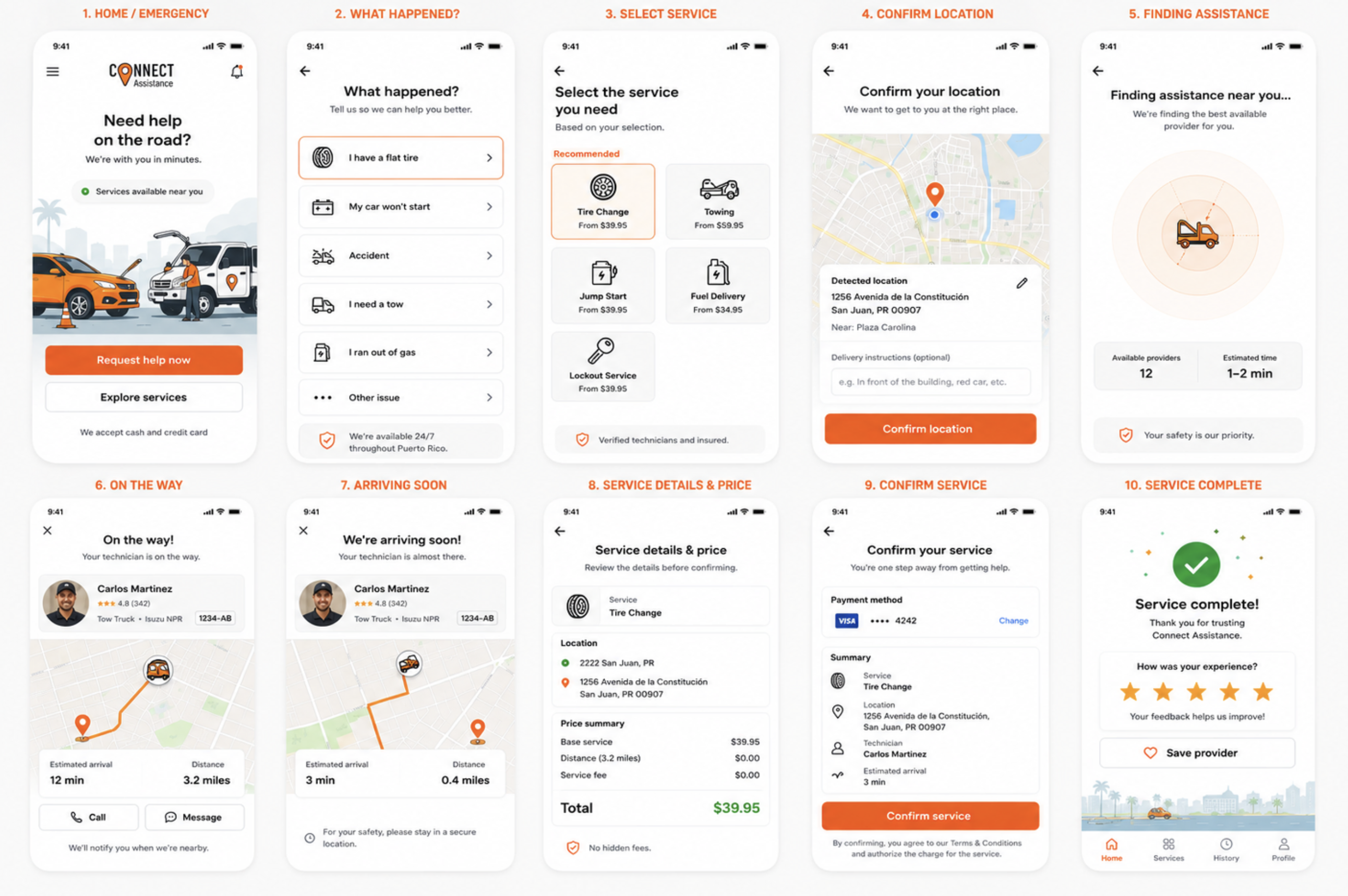
The flow is intentionally linear — there are very few branches or decision points. In a stressful moment, optionality is the enemy. The app guides users through one clear path to get help, with escape hatches only where truly necessary.
What guided
every decision
Calm is a design choice
Color, typography, spacing, and copy were all chosen to reduce arousal and project stability. No alarming reds, no urgent all-caps, no countdown timers.
The fastest path wins
Every extra tap is a failure. The design constantly asks: can this be inferred, automated, or removed? Fewer decisions = faster help.
Transparency builds trust
Prices, technician details, and location are surfaced proactively — not buried. Users shouldn't have to wonder what's happening or what it will cost.
Design for the wait
The experience doesn't end at confirmation. The waiting state — live map, technician ETA, real-time updates — is as important as the request flow itself.